➤
Crisis, Emergency and Business Continuity Management

Course Description

In today's increasingly complex and interconnected business environment, organizations face a wide range of threats that can disrupt operations, endanger personnel, damage critical assets, and threaten business sustainability. These threats include industrial accidents, natural disasters, cybersecurity incidents, infrastructure failures, supply chain disruptions, security threats, and geopolitical uncertainties.

The Crisis, Emergency and Business Continuity Management training program provides managers, executives, and professionals with the knowledge, practical skills, and leadership capabilities required to effectively prepare for, respond to, manage, and recover from emergencies, crises, and major business disruptions.

The program integrates emergency preparedness, incident command, crisis leadership, risk assessment, business impact analysis, crisis communication, business continuity planning, and operational recovery into a comprehensive organizational resilience framework.

Drawing upon internationally recognized standards and guidelines, including ISO 22301:2019, ISO 22361:2022, ISO 22320:2018, ISO 31000:2018, and AE/SCNS/NCEMA 7000:2021, the course bridges the gap between theoretical management frameworks and real-world organizational challenges.

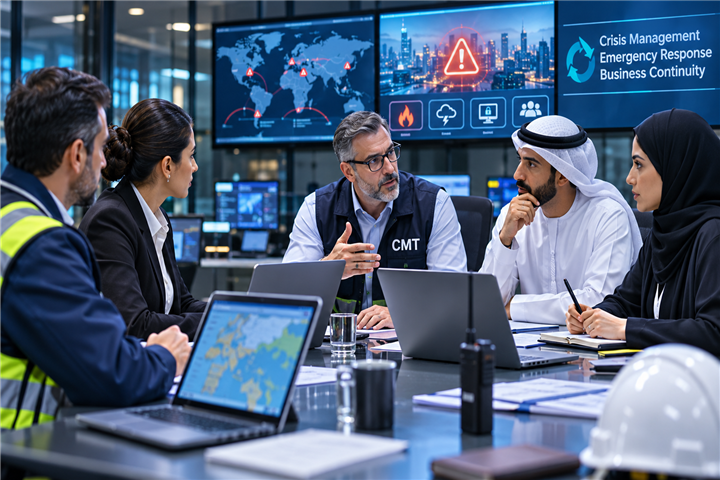
Participants will explore the strategic, tactical, and operational aspects of crisis and emergency management, including the roles and responsibilities of Emergency Response Teams (ERT), Emergency Management Teams (EMT), Crisis Management Teams (CMT), and Incident Commanders.

Through interactive discussions, practical workshops, real-world case studies, management decision-making exercises, and facilitated tabletop simulations, participants will develop the capabilities required to lead teams under pressure, coordinate response activities, communicate effectively with stakeholders, maintain critical business functions, and facilitate organizational recovery.

The program is applicable across a wide range of industries, including oil and gas, petrochemicals, power generation, utilities, manufacturing, construction, aviation, maritime operations, transportation, logistics, healthcare, financial services, telecommunications, government organizations, and critical infrastructure.

Customized Corporate Training

For corporate clients, NAFTA offers customized training solutions tailored to each organization's operational risks, management structures, regulatory requirements, and existing emergency and crisis management arrangements.

The program can incorporate organization-specific Emergency Response Plans, Crisis Management Plans, Business Continuity Plans, internal escalation procedures, command and control structures, and realistic industry-specific crisis scenarios.

This approach ensures that participants develop practical competencies relevant to their actual responsibilities and operating environment, rather than relying solely on theoretical knowledge.

Course Objectives

Upon successful completion of this training program, participants will be able to:

  • Understand the fundamental principles of crisis management, emergency management, business continuity, and organizational resilience.
  • Differentiate between incidents, emergencies, crises, disasters, and major business disruptions.
  • Understand relevant international standards, guidelines, and regulatory frameworks.
  • Identify organizational threats, vulnerabilities, critical dependencies, and operational risks.
  • Apply risk assessment and Business Impact Analysis (BIA) methodologies.
  • Establish business continuity objectives and recovery priorities.
  • Develop and evaluate effective emergency preparedness and response arrangements.
  • Understand Incident Command System (ICS) principles and management structures.
  • Define the roles and responsibilities of ERT, EMT, and CMT members.
  • Assess incidents, determine escalation requirements, and activate appropriate response arrangements.
  • Demonstrate effective leadership and decision-making under pressure and uncertainty.
  • Establish effective command, control, communication, and coordination mechanisms.
  • Manage internal and external stakeholder communications during emergencies and crises.
  • Develop business continuity strategies and operational recovery arrangements.
  • Prioritize personnel safety, environmental protection, asset integrity, and critical business operations.
  • Manage emerging threats, complex disruptions, and cascading crisis events.
  • Participate in and evaluate realistic crisis management tabletop exercises.
  • Conduct structured post-incident reviews and identify organizational improvement opportunities.
  • Strengthen organizational preparedness, response capabilities, and long-term resilience.

Audience

This training program is designed for professionals responsible for organizational leadership, emergency preparedness, crisis response, business continuity, and operational resilience, including:

  • Senior Executives and Directors
  • General Managers and Department Heads
  • Operations and Plant Managers
  • Crisis Management Team (CMT) Members
  • Emergency Management Team (EMT) Members
  • Emergency Response Team (ERT) Leaders
  • Incident Commanders and Emergency Coordinators
  • HSE Managers, Engineers, and Professionals
  • Business Continuity Managers and Coordinators
  • Risk Management and Compliance Professionals
  • Security and Emergency Response Managers
  • Facility and Infrastructure Managers
  • IT and Cybersecurity Managers
  • Supply Chain and Logistics Managers
  • Corporate Communications and Public Relations Professionals
  • Government and Public Sector Officials
  • Organizational Resilience Professionals
  • Professionals responsible for emergency preparedness and business continuity

Prerequisites

There are no mandatory formal prerequisites for attending this training program.

A basic understanding of organizational operations, management responsibilities, risk management, health and safety, or emergency response arrangements is beneficial.

For customized corporate training programs, familiarity with the organization's existing emergency response, crisis management, and business continuity procedures is recommended.

Course Content

  • Module 1: Fundamentals of Crisis, Emergency and Business Continuity Management
    • Definitions and characteristics of incidents, emergencies, crises, and disasters
    • Differences between emergency management, crisis management, and business continuity management
    • Crisis and emergency management lifecycle
    • Prevention, mitigation, preparedness, response, and recovery
    • Organizational resilience and operational preparedness
    • Integration of emergency response, crisis management, and business continuity frameworks
    • Organizational governance and management accountability
    • Leadership responsibilities throughout the crisis lifecycle
    • Developing an organizational preparedness culture
  • Module 2: International Standards and Regulatory Frameworks
    • Overview of internationally recognized standards and guidelines
    • ISO 22301:2019 – Business Continuity Management Systems
    • ISO 22361:2022 – Crisis Management Guidelines
    • ISO 22320:2018 – Guidelines for Incident Management
    • ISO 31000:2018 – Risk Management Guidelines
    • ISO 22316:2017 – Organizational Resilience
    • ISO/TS 22317:2021 – Guidelines for Business Impact Analysis
    • ISO 22398:2013 – Guidelines for Exercises
    • AE/SCNS/NCEMA 7000:2021 – UAE National Standard for Business Continuity Management
    • National and industry-specific regulatory requirements
    • Integration with existing organizational management systems
    • Regulatory compliance and organizational governance
  • Module 3: Risk Assessment and Business Impact Analysis
    • Hazard, threat, and vulnerability identification
    • Internal and external organizational risk factors
    • Risk assessment methodologies and prioritization
    • Identification of critical business functions and processes
    • Business Impact Analysis (BIA) methodology
    • Operational, financial, reputational, and regulatory impacts
    • Critical infrastructure and organizational interdependencies
    • Maximum Tolerable Period of Disruption (MTPD)
    • Recovery Time Objective (RTO)
    • Recovery Point Objective (RPO)
    • Minimum Business Continuity Objective (MBCO)
    • Critical resource requirements
    • Risk mitigation and preparedness strategies
  • Module 4: Emergency Preparedness and Response Management
    • Emergency preparedness principles and frameworks
    • Development and implementation of Emergency Response Plans (ERP)
    • Emergency classification and severity assessment
    • Incident identification, notification, and reporting
    • Emergency escalation and activation procedures
    • Emergency response mobilization
    • Evacuation and shelter-in-place arrangements
    • Personnel accountability and protection
    • Emergency facilities, equipment, and resource requirements
    • Coordination with external emergency services
    • Management oversight of operational and industrial emergencies
    • Emergency stand-down and transition to recovery
  • Module 5: Incident Command and Crisis Management Structures
    • Incident Command System (ICS) principles
    • Emergency management organizational structures
    • Operational, tactical, and strategic management levels
    • Emergency Response Team (ERT) responsibilities
    • Emergency Management Team (EMT) responsibilities
    • Crisis Management Team (CMT) responsibilities
    • Incident Commander roles and responsibilities
    • Command, control, coordination, and decision-making authority
    • Emergency Operations Centers (EOC)
    • Establishing effective reporting and communication lines
    • Transfer of command and management responsibilities
    • Transition from operational emergency response to strategic crisis management
    • Coordination between internal and external response organizations
  • Module 6: Crisis Leadership and Decision-Making
    • Leadership principles during emergencies and crises
    • Strategic, tactical, and operational decision-making
    • Decision-making under pressure and uncertainty
    • Managing incomplete, conflicting, and rapidly changing information
    • Situational awareness and common operating picture
    • Human factors and cognitive biases
    • Prioritization of personnel safety, environmental protection, and asset integrity
    • Resource allocation and competing operational priorities
    • Management of stress, fatigue, and team performance
    • Ethical decision-making and management accountability
    • Leadership effectiveness during prolonged crises
    • Maintaining organizational confidence and workforce morale
  • Module 7: Crisis Communication and Stakeholder Management
    • Principles of effective emergency and crisis communication
    • Development of crisis communication strategies and protocols
    • Internal communication and management reporting
    • Emergency notification and communication systems
    • Communication between operational, tactical, and strategic teams
    • Stakeholder identification and communication requirements
    • Communication with government authorities and regulatory bodies
    • Coordination with external emergency services
    • Media management and public relations
    • Spokesperson responsibilities and crisis messaging
    • Social media monitoring and misinformation management
    • Reputation management and stakeholder confidence
    • Communication with employees, customers, contractors, and affected communities
  • Module 8: Business Continuity Planning and Operational Recovery
    • Business continuity management principles and strategies
    • Development and implementation of Business Continuity Plans (BCP)
    • Business continuity governance and management responsibilities
    • Activation of business continuity arrangements
    • Maintaining essential business functions during disruptions
    • Alternative operating arrangements and contingency strategies
    • Management of critical resources and dependencies
    • Supply chain and third-party continuity management
    • IT disaster recovery and data continuity considerations
    • Recovery strategies and operational restoration
    • Coordination of recovery resources and activities
    • Phased recovery and return to normal operations
    • Business continuity plan testing, maintenance, and improvement
  • Module 9: Emerging Threats and Complex Crisis Scenarios
    • Major industrial accidents and operational disruptions
    • Fire, explosion, and hazardous material incidents
    • Critical equipment and infrastructure failures
    • Natural disasters and extreme weather events
    • Cybersecurity incidents and IT/OT disruptions
    • Physical security threats
    • Geopolitical disruptions and regional uncertainties
    • Supply chain and logistics interruptions
    • Power, water, and telecommunications outages
    • Public health emergencies and workforce disruptions
    • Environmental emergencies
    • Cascading failures and interconnected risks
    • Management of simultaneous and prolonged crisis events
  • Module 10: Crisis Simulation and Practical Tabletop Exercises
    • Principles of emergency and crisis management exercises
    • Types of exercises and simulation methodologies
    • Exercise objectives, planning, and scenario development
    • Development of realistic crisis scenarios and exercise injects
    • Incident assessment and emergency classification
    • Activation of emergency and crisis management teams
    • Establishment of command and control arrangements
    • Leadership and management decision-making under pressure
    • Emergency communication and stakeholder coordination
    • Resource management and operational prioritization
    • Business continuity activation and recovery planning
    • Evaluation of individual and team performance
    • Facilitated debriefing and exercise feedback
    • Identification of organizational and procedural improvement opportunities
  • Module 11: Post-Crisis Review and Organizational Resilience
    • Post-emergency and post-crisis management
    • Incident documentation and management reporting
    • Structured debriefing and After-Action Review (AAR)
    • Identification of lessons learned
    • Evaluation of response effectiveness
    • Identification of organizational, procedural, and competency gaps
    • Development of corrective and preventive actions
    • Emergency and crisis management performance indicators
    • Management review and continuous improvement
    • Training, competency development, and exercise programs
    • Strengthening organizational resilience and preparedness culture
    • Integration of lessons learned into emergency and business continuity plans
  • Practical Workshops and Scenario-Based Exercises
    Depending on the selected training format and organizational requirements, practical activities may include:
    • Organizational Risk Assessment Workshop
    • Business Impact Analysis (BIA) Workshop
    • Emergency Classification and Escalation Exercise
    • Incident Command and Crisis Team Activation Exercise
    • Crisis Leadership and Decision-Making Workshop
    • Crisis Communication and Stakeholder Management Exercise
    • Business Continuity and Recovery Planning Workshop
    • Integrated Crisis Management Tabletop Simulation
    • Post-Incident Review and Lessons Learned Workshop

Practical exercises and scenarios can be customized to reflect the participants' industry, operational environment, organizational structure, and specific risk profile.

comments (0)

leave a comment