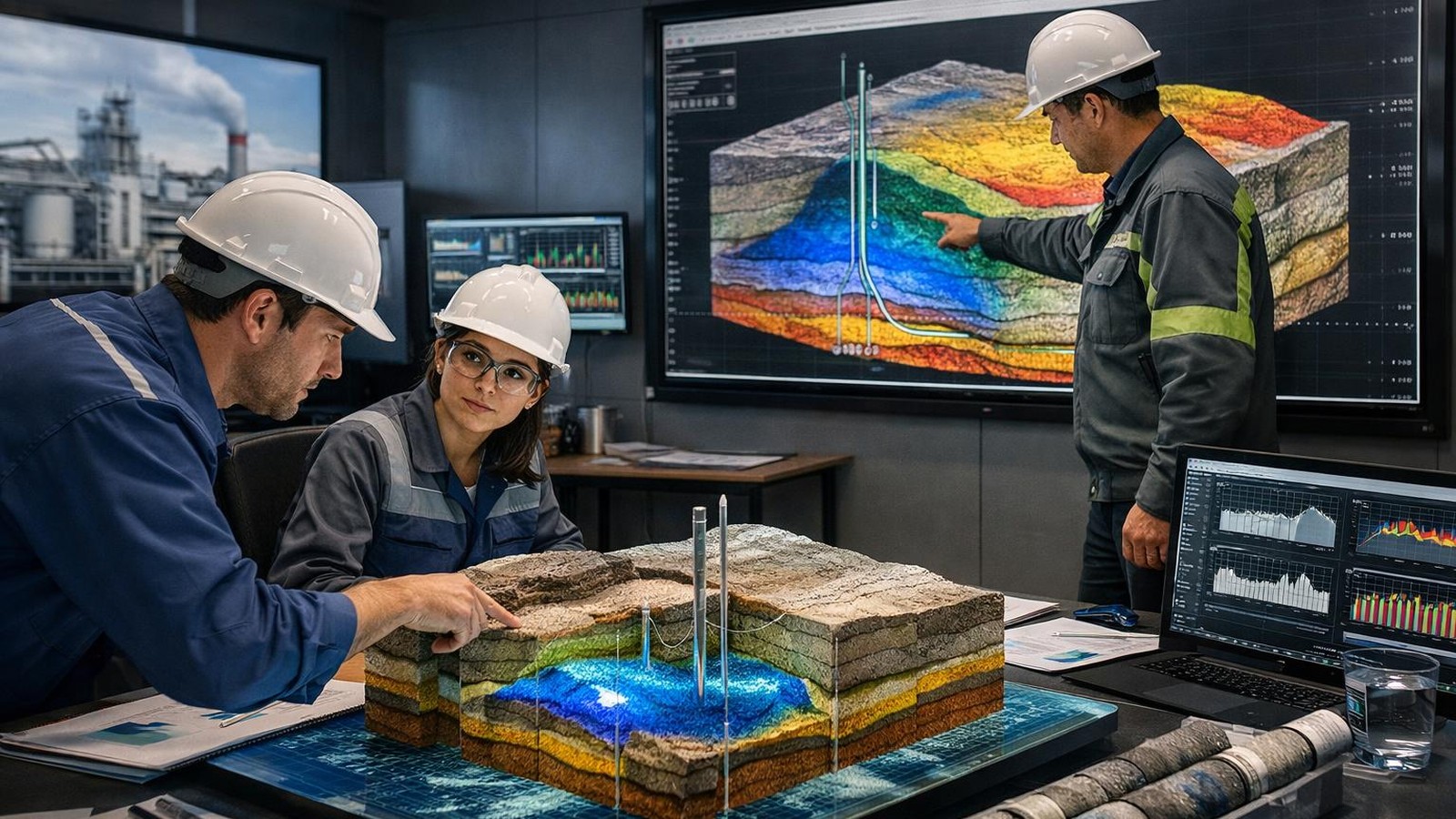
Course Description

Carbon Capture, Utilization and Storage (CCUS) is a key technology for reducing industrial greenhouse gas emissions and supporting the transition toward lower-carbon energy systems. It provides an integrated pathway for capturing carbon dioxide from industrial sources, transporting it safely, utilizing it in value-generating applications, or permanently storing it in suitable geological formations.

This course provides participants with a practical understanding of the complete CCS and CCUS value chain, including CO₂ capture technologies, transportation systems, geological storage, monitoring, project development, regulatory requirements, economics, and risk management. Particular attention is given to upstream applications, including storage in depleted oil and gas reservoirs, saline aquifers, and the use of CO₂ for Enhanced Oil Recovery.

Participants will examine the properties and behavior of CO₂ during transportation, injection, and long-term storage. The program also addresses site screening, reservoir characterization, injectivity, containment, fault and seal assessment, well integrity, geochemical and geomechanical effects, monitoring and validation strategies, and project lifecycle planning.

Practical exercises and international case studies enable participants to evaluate prospective storage sites, recognize technical and operational risks, and develop an integrated understanding of how CCS and CCUS projects are planned, assessed, implemented, monitored, and ultimately closed.

Course Objectives

  • Understand the complete CCS and CCUS value chain, from CO₂ capture and transportation to utilization and permanent geological storage.
  • Explain the role of CCS and CCUS in emissions reduction, energy transition, and industrial decarbonization.
  • Compare CO₂ capture technologies, transportation options, utilization pathways, and geological storage mechanisms.
  • Evaluate depleted oil and gas reservoirs, saline aquifers, and other formations for potential CO₂ storage.
  • Understand the principles and applications of CO₂ Enhanced Oil Recovery.
  • Assess storage capacity, injectivity, sealing potential, plume migration, and long-term containment.
  • Recognize geological, geomechanical, geochemical, operational, and well integrity risks associated with CO₂ injection.
  • Understand the requirements for designing CO₂-resistant injection and monitoring wells.
  • Develop appropriate monitoring, reporting, and verification strategies for CCS and CCUS projects.
  • Review project economics, carbon credits, regulatory frameworks, business models, and international project experience.
  • Apply storage screening, risk assessment, fault analysis, and project development principles through practical exercises and case studies.

Audience

Engineers, technicians, supervisors, managers, and other professionals involved in the relevant technical or business function.

Prerequisites

No formal prerequisites are required. Relevant education or industry experience is beneficial.

Course Content

Climate Change and the Role of CCS

  • Greenhouse gas emissions and global climate objectives
  • IPCC pathways, net-zero scenarios, and industrial decarbonization
  • The role of CCS and CCUS in oil, gas, power, and heavy industries
  • History, current status, and future development of global CCS projects
  • International and regional CCS initiatives

CCS and CCUS Technology Overview

  • Pre-combustion, post-combustion, and oxy-fuel capture technologies
  • CO₂ conditioning, compression, dehydration, and impurity management
  • Transportation by pipeline and ship
  • Differences between carbon capture and storage and carbon capture, utilization and storage
  • CO₂ utilization pathways
  • Carbon-neutral LNG, hydrogen, ammonia, and methanation

Geological Storage Fundamentals

  • CO₂ physical and thermodynamic properties
  • Storage in depleted oil and gas reservoirs
  • Storage in deep saline aquifers
  • Structural, residual, solubility, and mineral trapping mechanisms
  • Reservoir capacity, injectivity, and pressure management
  • Caprock integrity, sealing capacity, and plume migration
  • Storage resource classification and estimation

CO₂ Enhanced Oil Recovery

  • Principles and mechanisms of CO₂ EOR
  • Miscible and immiscible displacement
  • Reservoir and fluid screening criteria
  • Injection strategies and recycling systems
  • Balancing enhanced recovery with permanent CO₂ storage
  • Technical and economic evaluation of CO₂ EOR opportunities

Storage Site Screening and Characterization

  • Regional and site-specific screening criteria
  • Geological, geophysical, petrophysical, and reservoir data requirements
  • Reservoir modeling and prospective storage resource estimation
  • Fault and seal characterization
  • Legacy well identification and assessment
  • Storage site ranking and decision-making
  • Practical storage screening exercise

Containment and Injection Risks

  • Leakage pathways and geological containment risks
  • Fault reactivation and induced seismicity
  • Pressure buildup and geomechanical response
  • CO₂-brine-rock interaction and geochemical effects
  • Impact of impurities on injection and storage performance
  • Risk assessment using bowtie and structured risk analysis methods

Well Design and Integrity

  • Injection and monitoring well design considerations
  • Materials selection for CO₂ service
  • Cement and casing compatibility
  • Well barriers and long-term integrity
  • Assessment of existing and abandoned wells
  • Plugging and abandonment considerations
  • Designing CO₂-resistant wells

CO₂ Injection and Reservoir Performance

  • Injection strategy and rate selection
  • Pressure and plume development
  • Reservoir simulation principles
  • Injectivity and pressure constraint analysis
  • Integrated containment risk assessment
  • Practical CO₂ injection simulation exercise

Monitoring, Reporting and Verification

  • Objectives of monitoring and validation
  • Subsurface and surface monitoring techniques
  • Seismic, pressure, temperature, geochemical, and well-based monitoring
  • CO₂ plume tracking and pressure monitoring
  • Leak detection and environmental surveillance
  • Development of an integrated monitoring and validation plan

Project Development and Economics

  • CCS project lifecycle from screening to closure
  • Feasibility, appraisal, development, operation, and decommissioning
  • Integration with existing oil and gas infrastructure
  • Capital and operating cost drivers
  • Carbon pricing, credits, incentives, and revenue models
  • Commercial structures and business models

Regulations and International Case Studies

  • International standards and regulatory frameworks
  • Environmental permitting and liability
  • Long-term stewardship and transfer of responsibility
  • Lessons learned from major international CCS and CCUS projects
  • Storage development planning workshop
  • Integrated project case study and group discussion

comments (0)

leave a comment