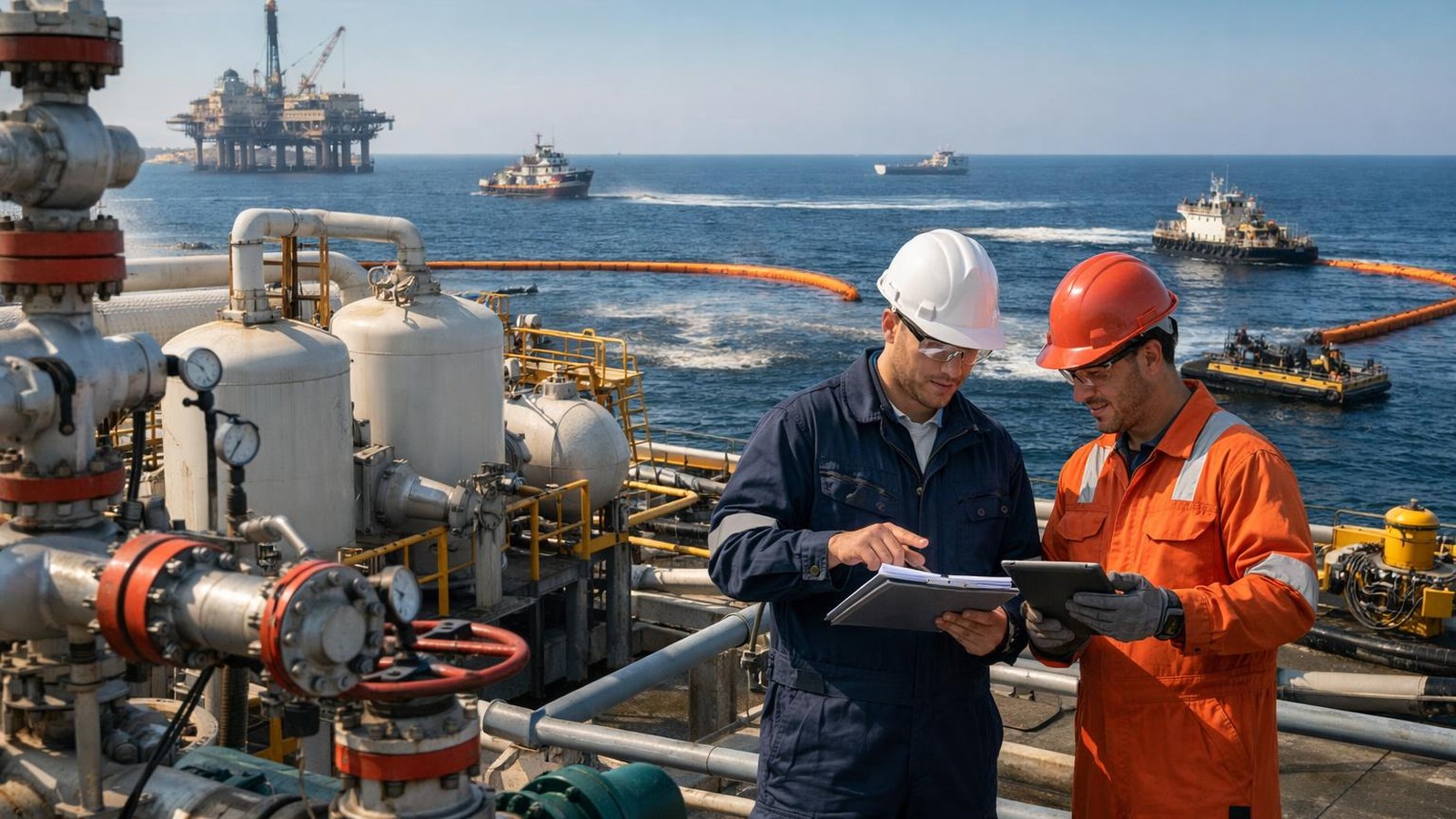
Course Description

About the Course:

The refining and transfer of oil cargoes are processes that entail many

risks. One of these potential risks is potential oil spills which could

result in devastation to the marine and coastal environments and have a

negative impact on the production and export operations. Hence, all

personnel dealing with oil cargoes should be familiar with oil spill

hazards, response, and crisis management operations in cases of larger

spills.

This course introduces all types of marine pollution, methods of marine

surveillance and then focusing on oil spill and its cleanup technologies.

Course Objectives

By the end of this course, participants will be able to understand and apply the key concepts, tools, and practices covered in the program.

Audience

This course targets those new member staff who are on Supervisor level as

Response Officers or so, or Managerial level who have just joined the

Marine Environment Pollution Sector. The course is adequate for personnel

working in Government and Industries (Environmental Affairs) sectors.

Prerequisites

No formal prerequisites are required. Relevant education or industry experience is beneficial.

Course Content

  • The main types of marine pollution and their impacts.
  • Oxygen demanding wastes (sewage).
  • Oil. Nature of oil, sources, potential impact.
  • Metals and radioactivity.
  • Halogenated hydrocarbons.
  • Case studies: Mediterranean and Caspian, Red Sea, ROPME Sea Area.
  • Data collection, data analysis and data synthesis.
  • Survey objectives, defining objectives and generating solution.
  • Planning considerations: sites, stations and samples.
  • Samples size and number, statistical requirements.
  • Compatibility and reproducibility of survey methodologies.
  • Surveying marine resources.
  • Ocean diffusion. The diffusion equation.
  • Practical solutions. The Okubo diagrams.
  • Shear diffusion. First stage growth. Radial spreading models.
  • Particle tracking methods.
  • Oil spill models. Hydrodynamic databases. Tidal and residual flows.
  • Simulation of evaporation and decay. Gas clouds.
  • Application of spill model to major incidents.
  • Sources of oil to the sea.
  • Different types of crude oil, properties of each oil.
  • Analysis - how do we analyse oil? Fingerprinting.
  • The problems caused by oils: ascetic, biologic, physical.
  • Accidents and processes of weathering.
  • Statistics of oil spills. Case studies of 'the worst oil spills'.
  • Introduction, windows of opportunity.
  • Booms and skimmers.
  • Dispersants and burning.
  • Shoreline clean up removal, washing, biodiesel.
  • Bioremediation.
  • Case studies.

comments (0)

leave a comment